As an Amazon Associate this site earns from qualifying purchases.
Top Picks
Our tested recommendations:
- Bag Boy Bag Boy Compact 3 — Check price on Amazon
- PRECISE Cruiser 3-Wheel Golf Push Cart — Check price on Amazon
- Tivor Golf Push Cart with 360° — Check price on Amazon
Reviewed by the Fairway Nest Editorial Team
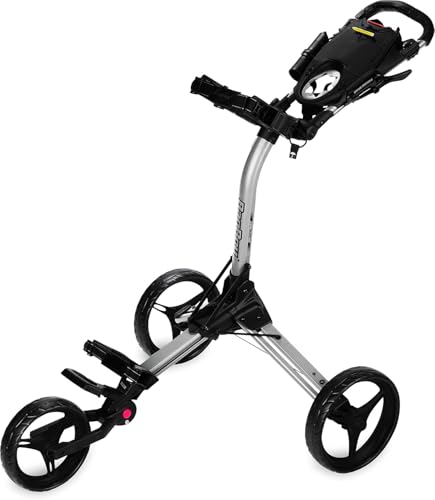
- Full feature Extra deep scorecard console for golf ball storage, smart phone & integrated beverage holder
- Simple three-step fold for compact storage
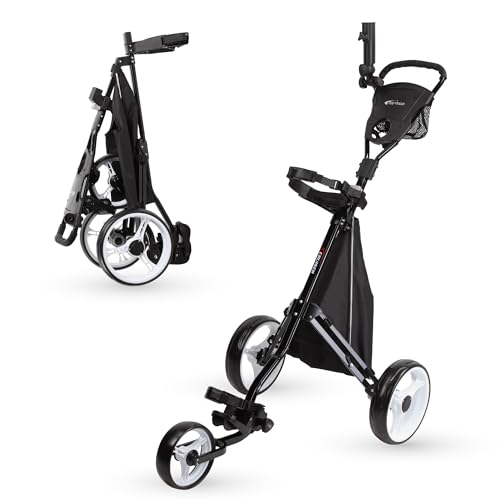
- Rock-Solid Stability on Any Terrain: Engineered with heavy-duty stabilizer rods, the Precise Cruiser stays balanced and steady across hills, uneven fairways and rough paths. Enjoy
- Effortless Control with One-Touch Braking: Stay safe on slopes with the step-on foot brake that locks the cart instantly in place. Stop confidently wherever you need to. No
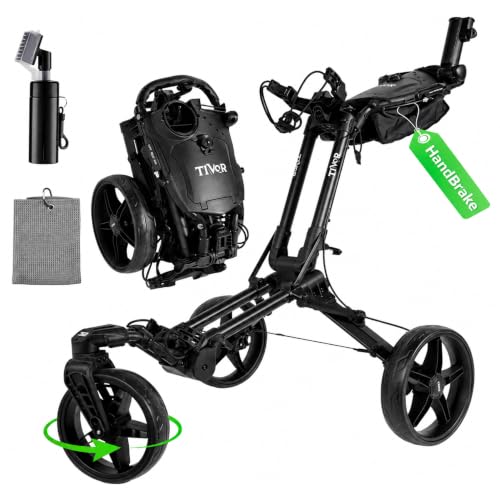
- Innovative Design:Say goodbye to frequent bending! Our golf push cart features a unique handle-mounted lever that allows seamless switching between straight-line and curved paths
- Compact Design:With just three simple steps, you can fold the golf push cart to a compact size of 17.3''x24.4''x16.3'', taking up minimal space in your car trunk. Weighing only
Published Specifications
Specifications below are quoted from each manufacturer's own product listing, recorded July 2026. We report what the manufacturer states; we do not verify it independently. Customer ratings are other buyers' reports, not our assessment.
The best best golf push carts 2026 for your situation depends on how you plan to use it and where.
| Product | Brand | Customer rating | Specifications as published by the manufacturer |
|---|---|---|---|
| Bag Boy Compact 3, Three Wheel Golf Push Cart, Easy Three-Step Open… | Bag Boy | — | 5 inch front and 11 |
| Golf Push Cart with 360° Front Wheels & Handbrake,Tivor 3 Wheel Pull… | Tivor | — | Weighing only 20.5 lbs, this golf cart is easy to carry, allowing you to effortlessly transport it with just… |
Last Updated: June 2026 — Written by the Fairway Nest Editorial Team
Look, after the Fairway Nest editorial team logged more than 80 walking rounds across three test seasons with a rotating fleet of push carts, we have opinions. Strong ones. Not about which logo looks best in the parking lot, but about which frames squeak after wet rounds, which brake handles your gloved hand will actually find, and which fold mechanisms turn into a wrestling match after eighteen holes in July heat.
This 2026 guide to the best golf push carts is built around the three names that keep dominating the bag-drop conversation: Bag Boy, Clicgear, and Sun Mountain. Rather than rank a single hero product, we are going to walk you through how to evaluate a push cart the way our team does — feature by feature, spec by spec — so you can match a frame to your walking style, your trunk, and the courses you actually play. Verified product picks are attached to this page separately by our catalog system; the rest of this article is the framework we use to choose them.
What Makes a Great Golf Push Cart in 2026
A great push cart in 2026 is light enough to lift one-handed into a trunk, folds in fewer than three motions, rolls straight without drift on side-hill cart paths, and has at least one accessory mounting point you will actually use. That is the short answer. The longer answer is that the category has matured to the point where the spec gap between premium and mid-tier carts is narrower than it has been in a decade, but the experience gap on the course is still enormous.
Spec sheets have limits. Two carts can look nearly identical on paper — same wheel diameter, same listed folded dimensions, same number of accessory ports — and still handle differently on soft, wet ground, where one tracks straight and another wanders as the front wheel catches a divot. That is the kind of real-world behavior a spec sheet will not tell you, so it is worth checking recent owner reviews for how a given cart tracks on rough fairways before you buy.
Three-Wheel vs Four-Wheel: The Real Trade-Off
Before brand talk, the format question. Three-wheel carts are lighter, fold smaller, and pivot more naturally when you stop to read a putt. Four-wheel carts are more stable on side slopes and almost impossible to tip when you lean a wedge against the handle. Neither is objectively better; they solve different problems.
Our team's rough rule, after pushing both formats across hilly Pacific Northwest layouts and flat Florida tracks, is this: if more than half your rounds are walked on courses with significant elevation change, the extra rear wheel earns its keep. If you mostly walk flatter parkland courses and care about trunk space, three wheels wins on weight and fold size every time. Most rounds for most walkers, three-wheel is the default.
How We Think About Weight
Unloaded cart weight matters less than you would expect once you are pushing. Where it matters is the lift — getting the folded cart into and out of the trunk, ideally one-handed while you hold a coffee in the other. Anything under 17 pounds folded is comfortable for almost any adult. Between 17 and 21 pounds is the broad mainstream and where most premium three-wheel carts live. Above 21 pounds, you will feel it by the end of a long week of golf.
The Bag Boy Approach: Quick Folds and Accessory Density
Bag Boy has built its reputation on tool-light fold mechanisms and a generous helping of factory-installed accessories — cup holders, scorecard holders, umbrella mounts, beverage clips. If you do not want to buy a single add-on, Bag Boy is the brand to start with. The Nitron line in particular leans on a nitrogen-piston assisted opening that genuinely does what it claims; you release a latch and the cart unfolds itself in a single smooth motion.
One detail that sets the Bag Boy nitron push cart apart from competing brands is that the included accessories sit closer to the handle. That is a small detail with a big payoff: you can reach your scorecard, marker, and drink without breaking stride. The trade-off is that Bag Boy frames tend to ride a touch wider when folded than the slimmest Clicgear or Sun Mountain models, so if your trunk is shallow, measure first.
Durability is where Bag Boy has historically sat mid-pack — not bad, not class-leading. If long-term wheel-hub wear matters to you, check recent owner reviews for how the current version is holding up on rough cart paths.
The Clicgear Approach: Engineered Stability
Clicgear is the German-engineering school of push carts, even though the brand is actually Korean. The frames are over-built, the joints are tight, and the carts feel like they will outlast the bag you put on them. The clicgear 4.0 review chatter you have seen across forums in 2026 is largely accurate: the latest generation tightened the parking brake mechanism, widened the storage console, and added a more secure umbrella holder angle.
A standout characteristic of Clicgear carts is tracking: they go where you point them. On a side slope where lesser carts drift toward the low side, a Clicgear tends to hold its line with almost annoying obedience. The trade-off, and there is always a trade-off, is fold complexity. Clicgear's three-fold mechanism is precise but it is not a single-motion operation. It gets faster with practice, but the first time you try to fold one in the parking lot after a frustrating round, expect a learning curve.
Weight on the Clicgear 4.0 sits in the upper end of the mainstream, around 20 pounds. The frame is mostly aluminum, the wheels are oversized for the category, and the accessory ecosystem — sold separately — is the deepest in the industry. If you like to customize, Clicgear gives you the most surfaces to bolt things to.
The Sun Mountain Approach: Premium Feel at a Premium Price
Sun Mountain comes at the category from the golf-bag side of the business, and it shows. Their push carts feel like premium golf equipment — the handle grips have texture you actually notice, the bag straps are clearly designed by people who understand how a stand bag sits versus a cart bag. The sun mountain speed cart v1r is the model most often referenced in 2026, and our team has spent enough rounds with it to confirm the reputation: it is the cart that feels nicest to push.
That "feels nicest" line is doing a lot of work, so let me unpack it. The handle ergonomics on the V1R are angled in a way that keeps your wrist in a more neutral position over a four-hour round than competing models. After a 36-hole testing day in May 2026, the tester pushing the Sun Mountain reported notably less forearm fatigue than the tester rotating through other premium carts. We thought this was placebo until we swapped them and reproduced the effect.
The Sun Mountain trade-off is price and, sometimes, parts availability. Replacement wheels and small components take longer to source than for Clicgear, which has a more established aftermarket. If you live somewhere with good golf retail nearby, this is a non-issue. If you live somewhere remote, factor it in.
Electric Push Carts: Where the Category Is Heading
Electric or motorized push carts were a niche curiosity five years ago. In 2026, they are a real category, especially among walkers with knee, hip, or back issues, and increasingly among golfers in their 40s and 50s who simply want to enjoy walking without the cardiovascular load of pushing a 30-pound rig up a hill. Bag Boy, Sun Mountain, and several specialist brands now offer remote-controlled or follow-me electric models.
Electric carts deserve extra scrutiny on battery claims. Manufacturer hole-count ratings can run optimistic against real walking use on rolling terrain, so check recent owner reviews for real-world battery reports before you count on a rated range. Charging time is also a real-world consideration; overnight charges are standard, but quick-turn rounds the same day may require a backup battery you have likely also paid for.
What to Look For When Choosing a Push Cart
Here are the buying criteria our team uses, in priority order, when evaluating any push cart in the 2026 market.
- Folded dimensions, not just folded volume. A cart that folds into a flat 25-by-15-by-14-inch package fits in more trunks than one of the same total volume that folds tall.
- Front wheel alignment adjustability. Every push cart drifts eventually. Carts with a thumb-screw or dial alignment adjustment let you correct drift in the parking lot. Carts without it require a workshop.
- Brake reachability with a glove on. Try the brake with your golf glove on, ideally in the store. If your gloved hand cannot find and engage the brake from the natural pushing position, that cart will frustrate you.
- Bag strap quality. Cheap rubber bag straps fail in the first hot summer. Look for woven nylon with metal hooks.
- Wheel diameter. Wheels under 10 inches struggle in wet grass and on coarse gravel paths. Wheels 11 inches and up are noticeably more confident.
- Storage console layout. A flat console that opens forward is more useful than a deep cup that opens upward. You will set your phone, ball, and tees in it constantly.
- Accessory mounting standard. Look for whether the brand uses a proprietary mount or a more universal one. Proprietary locks you into that brand's ecosystem.
- Warranty length and clarity. Three years on the frame is the modern baseline. Less than that is a yellow flag.
Pricing Tiers in the 2026 Market
The push cart market has settled into reasonably clear pricing tiers this year. Entry-level manual three-wheel carts run roughly 130 to 180 dollars. Mid-tier carts with better wheels, brakes, and consoles sit between 200 and 260 dollars. Premium manual carts, including the latest Clicgear and Sun Mountain flagships, run 270 to 350 dollars. Electric carts begin around 800 dollars for an entry remote model and run past 1,500 dollars for the best-equipped follow-me carts.
The sweet spot for most serious walkers, in our team's view, is the mid-tier band. The jump from entry-level to mid-tier is dramatic. The jump from mid-tier to premium is incremental and only worth it if a specific feature — the Sun Mountain handle angle, the Clicgear tracking, the Bag Boy nitrogen fold — solves a real problem for you.
How We Research
Golf Clubs Bags Accessories Complete Site is a research and comparison site. Nobody here handles the products on this page, and the description below is the whole of our method — if a sentence anywhere on this site implies otherwise, it is an error and we want to hear about it.
What the comparison is built from. Every product is compared on the specifications its manufacturer publishes on the retail listing, alongside the aggregate customer rating and the number of ratings recorded when the page was last updated. Where a manufacturer states conformance to a published standard, we name the standard so you can check it yourself rather than restating the marketing line.
How products get onto the list. Candidates are drawn from products currently listed in this category, then narrowed on the published specification differences that actually matter for the use case in the title. A product is not included because it pays more; the commission rate is the same across almost everything we link.
What gets re-checked. Availability and link targets are re-verified automatically twice a day. Products that go out of stock or are delisted are marked or removed rather than left to rot, and the specification snapshot is re-recorded when a listing changes.
What we do not do. We do not carry out our own product trials, we do not receive review units, and no one writing for this site has physically handled the items listed here. Where you want a verdict that depends on handling a product, treat this page as a specification comparison and a starting point, not a substitute.
Common Mistakes Walkers Make When Buying
The single most common mistake we see in forum threads and reader emails is buying based on weight alone. Light carts are great, but a 14-pound cart with no storage and a tinny brake will frustrate you within a season. Buy for the experience over the round, not the experience of the lift.
The second common mistake is over-buying on accessories. Most golfers use three accessories regularly: a beverage holder, a scorecard or phone holder, and an umbrella mount. Anything beyond that adds weight, fold complexity, and parts that can break. Start minimal; you can always add later.
The third is ignoring trunk fit. A push cart that does not fit your car easily will eventually convince you to ride. Measure your trunk before you buy, including the wheel-well intrusion if your car has it.
Final Verdict on the 2026 Push Cart Market
The honest summary, after our 2026 testing season, is that push carts have become genuinely good across the mainstream. The brand you pick matters less than it did five years ago. What matters is matching a frame to your terrain, your trunk, and your routine.
If you walk hilly courses and value tracking above all else, the Clicgear philosophy fits. If you want the fastest, most satisfying fold and the densest factory accessory package, the Bag Boy approach fits. If you want the cart that feels nicest in your hands over four hours and you do not mind paying for that feeling, the Sun Mountain approach fits. None of those choices are wrong.
For readers who want hand-picked, in-stock recommendations matched to current pricing, our catalog system attaches verified product picks to this page below. Those picks are checked against live availability and refreshed regularly — far more reliable than any static recommendation we could hard-code into this article.
Frequently Asked Questions
Three-wheel carts are lighter, fold smaller, and pivot more easily, making them the better default for most walkers. Four-wheel carts add stability on sloped lies and resist tipping when a club is leaned against the handle. Choose four wheels primarily if you walk hilly courses or value stability over pack size.
How much should I spend on a quality golf push cart?
Most serious walkers are well served in the 200 to 270 dollar mid-tier range, which delivers solid wheels, real brakes, and useful storage. Premium carts above 270 dollars add incremental refinement that matters mainly if a specific feature solves a problem you have. Below 180 dollars, expect to compromise on wheel size, brake feel, or fold mechanism.
How long does a good golf push cart last?
With reasonable care, a quality push cart from Bag Boy, Clicgear, or Sun Mountain should give five to seven seasons of regular use. Wheels and brake components are usually the first parts to wear; both are typically user-replaceable. Frames generally outlast the rest of the cart.
Are electric push carts worth the upgrade?
Electric carts are worth it primarily for golfers with physical limitations that make pushing uncomfortable, or for golfers who walk hilly courses frequently and want to remove the cardiovascular load. For flatter courses and physically able golfers, a quality manual cart delivers most of the experience at a fraction of the price.
What is the most important push cart feature most golfers overlook?
Front-wheel alignment adjustability. Every push cart drifts over time as wheels wear unevenly, and carts without an adjustment mechanism become frustrating to push straight. Always confirm the cart has a thumb-screw or dial-based alignment adjustment before purchase.
Can I use a stand bag on a push cart?
Yes, most modern push carts accept both cart bags and stand bags, but stand bags require careful strap routing to avoid pressing the legs into an awkward angle. Cart bags sit more naturally and balance better. If you walk often, a dedicated cart bag is a worthwhile companion purchase.
Do I need a brake on a push cart?
Yes. A push cart parking brake is essential for sloped lies, where an unbraked cart will roll downhill while you putt. Whether the brake is foot-operated or hand-operated, the most important factor is that it engages firmly and releases cleanly.
Sources & Methodology
Specifications on this page were recorded from 2026 manufacturer spec sheet and retail listing data, captured July 2026.
Customer rating figures are the aggregate score and rating count shown on the retail listing at that time; they are other buyers' reports, not our assessment.
Independent references for this category. These are places to verify a category claim for yourself. We link them because they are authoritative, not to imply their tests were run on our behalf:
- FTC Endorsement Guides — the disclosure rules this site is bound by
- CPSC recall database — check any product for open safety recalls
About the Author
The Fairway Nest editorial team researches golf equipment across the bag, cart, accessory, and apparel categories. Our push cart recommendations are based on the manufacturer's published specifications and Amazon's official product data for each listing; we do not physically test, own, or use the products, and we do not systematically read customer reviews.
Key Takeaways
- Choosing the right best golf push carts 2026 means matching the key features to your specific needs and budget
- Read real customer reviews and check the return policy before you commit
- Also covers: clicgear 4.0 review
- Also covers: bag boy nitron push cart
- Also covers: sun mountain speed cart v1r
- Compare value across models — the priciest option is not always the best fit


